A Framework for Entering a New African Market because Localization Isn't Translation
Most brands treat African market entry as a translation problem and wonder why it doesn't stick. This piece breaks down a four-layer localization framework, payment, pricing, distribution, and trust, using how Jumia and Netflix actually adapted to win, not just what they said in local languages.
Deborah Alifa
Intern · Jul 10, 2026
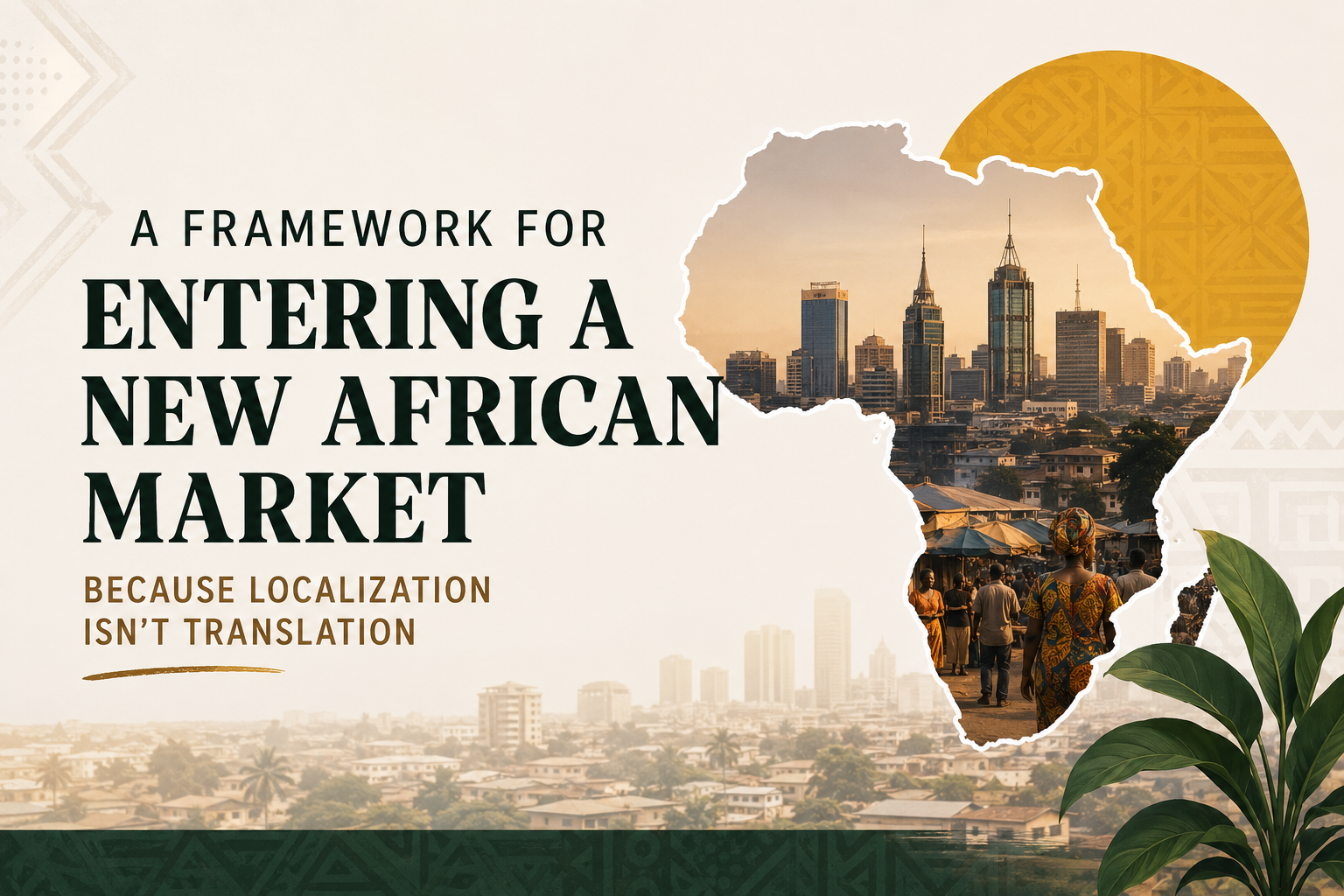
Translating a website into Swahili or Hausa is not localization. It is the smallest, least important part of it, and brands that treat the two as the same thing are the ones that quietly fail to gain traction six months after launch.
Africa is not one market. It is 54 countries, thousands of languages, and dramatically different payment habits, income levels, and trust signals from one border to the next. Yet most brands entering a new African market still approach localization as a translation task: swap the language, keep everything else, and call it market entry. This is precisely why so many promising launches stall.
What localization actually means in an African context
Localization is the systematic adaptation of a product, message, and operating model to match the economic, infrastructural, and cultural realities of a specific market, not just its language. Translation changes the words. Localization changes the offer.
The clearest proof of this distinction comes from companies that scaled across Africa precisely because they treated localization as a structural requirement, not a finishing touch. Jumia adapted its payment methods to match the realities of African consumers directly: because a majority of adults across its markets did not use a bank account, the platform built in cash-on-delivery and partnered with mobile money providers like MTN Mobile Money in Ivory Coast, rather than assuming card payment would simply work because it worked elsewhere. That single adaptation, not a translated homepage, is what let the platform's payment funnel actually convert.
Mobile money is not a niche workaround in African markets. It is the dominant rail. Deloitte data shows Africa leads the world in this category, with the majority of payments on the continent processed through a mobile device rather than a card or bank transfer. A brand that localizes its language but not its payment stack has not entered the market. It has built a storefront with no working till.
Why global models don't scale into Africa as-is
The single most common mistake in African market entry is assuming a model that worked in one region will transplant cleanly into another. It rarely does, and the gap is rarely about ambition or capital.
Jumia's own trajectory shows this clearly. The company raised more than 800 million dollars before its 2019 IPO on the strength of a model built for markets with reliable card payments and dense delivery infrastructure. The lesson the company eventually internalized was that a successful model elsewhere does not automatically translate to African markets, since price sensitivity, delivery expectations, payment habits, and search behavior all differ from one region to the next. Infrastructure compounds the problem further: only a small share of Jumia's markets had reliably paved roads, which meant a frictionless digital checkout still depended on a fragile, unreliable last mile that no amount of translated marketing copy could fix.
The pattern repeats outside e-commerce. Netflix's African and global expansion strategy depended on building mobile-only, lower-bandwidth subscription tiers and partnering directly with local telecom providers for payment, rather than assuming its standard global tier and card-based billing would simply work in markets with different connectivity and banking realities.
The four layers every localization framework needs
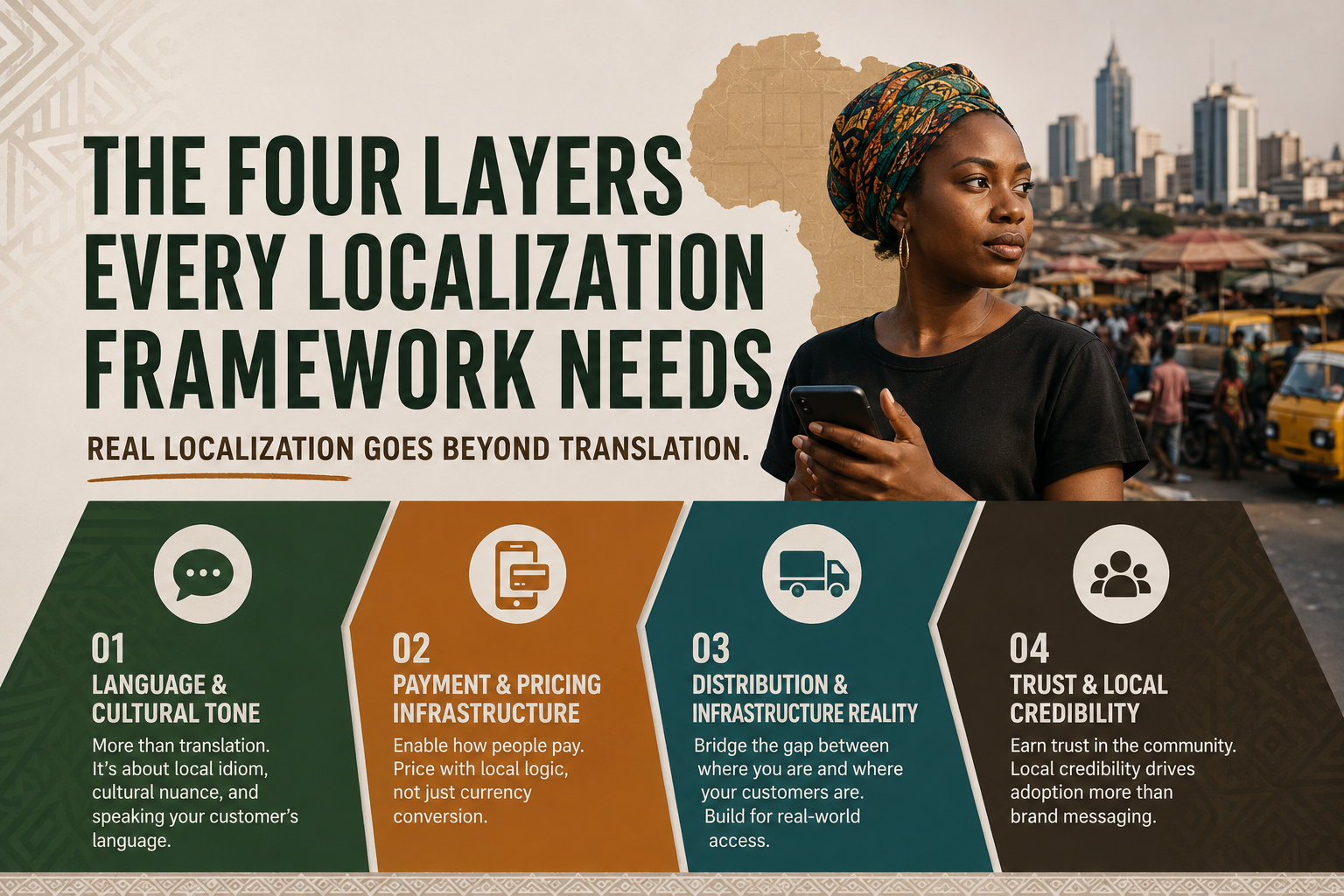
Real localization operates on four layers, and skipping any one of them is usually where market entry quietly breaks down.
Language and cultural tone. This is the layer most brands get right, because it is the most visible. Translating copy, adjusting tone for local idiom, and avoiding cultural missteps matters, but it is table stakes, not differentiation.
Payment and pricing infrastructure. This is the layer that determines whether a sale actually completes. Jumia's cash-on-delivery and mobile money integration directly addressed the reality that a large share of its addressable market was unbanked. Pricing also needs local logic, not a straight currency conversion: Jumia uses country-specific price ladders that reflect local inflation and foreign exchange swings rather than a single global price simply converted at the day's exchange rate.
Distribution and infrastructure reality. A product can be perfectly priced and perfectly translated and still fail if it cannot physically or digitally reach the customer. Jumia's decision to build its own delivery fleet, larger than DHL's footprint across its 12 markets, was a direct response to fragmented, unreliable third-party logistics across the region.
Trust and local credibility. African consumers route purchase decisions through community trust more than brand messaging. This is the layer brands most often skip entirely, assuming that a translated ad campaign will build the same credibility a known, locally embedded operator already has.
Why regional trade shifts make this more urgent, not less
The economic case for entering African markets is accelerating. Real GDP across the continent is projected to grow 4.1% in 2026, with 41% of African economies expected to grow at 5% or higher, nearly double the global average. Intra-African trade itself increased by 7.7% in 2024 alone, driven by the continued implementation of the African Continental Free Trade Area.
This matters directly for localization strategy. As AfCFTA lowers cross-border trade friction, more brands will be tempted to treat the continent as a single addressable market and scale one approach across it. The data argues against that. Growth is accelerating unevenly, market conditions remain genuinely distinct from Lagos to Nairobi to Accra, and the brands that win regional scale will be the ones that localize deliberately in each market rather than the ones that mistake reduced trade barriers for reduced market differences.
Globally, the cost of skipping this work is already measurable. Poor localization costs global businesses an estimated 20 percent of potential revenue annually, and over a third of companies surveyed had already delayed or pulled back from entering a market specifically because of localization challenges. Cost was the single biggest barrier cited, ahead of understanding the local market itself, which suggests many companies are treating localization as an expense to minimize rather than the infrastructure that determines whether expansion works at all.
How to apply this framework before entering a new African market
Audit the payment layer before the language layer. Map how your target customer actually pays for things today, mobile money, cash, agent banking, before translating a single word of marketing copy. If checkout doesn't match local payment behavior, language was never the bottleneck.
Price in local economic logic, not converted currency. Build pricing that accounts for local inflation, purchasing power, and competitive benchmarks specific to that market, the way Jumia's dynamic price ladders do, rather than applying a flat currency conversion from a global price point.
Treat distribution as a first-order strategic decision, not an operations afterthought. If the product cannot reliably reach the customer, no amount of demand generation will produce retained revenue. Decide early whether that means owned logistics, local partnerships, or a hybrid model, and resource it accordingly.
Borrow trust before asking for it. Local partnerships, known distributors, or community-embedded figures transfer credibility faster than any campaign can build it from zero. This is the layer most global entrants underinvest in, and it is usually the one local competitors already have.
In conclusion, a translated website is not a localized market entry. It is a market entry wearing local language while running on assumptions built somewhere else. The brands that actually win African markets, Jumia's payment infrastructure, Netflix's connectivity-adjusted tiers, are the ones that rebuilt the parts of their model that didn't match local reality, not just the words on the page.
As Africa's growth accelerates and trade barriers continue to fall, the opportunity to enter new markets will only grow. So will the cost of entering them with a translation instead of a strategy.
Building a market entry that actually holds up against local payment, pricing, distribution, and trust realities is strategic work, not a checklist. That is the kind of framework Antropee builds with brands entering African markets for the first time.
Written by
Deborah Alifa
Intern at Antropee. Writing about marketing strategy, brand-building, and growth in African markets.