THE DEATH OF OWNERSHIP IN THE WORLD OF AI PIRACY
Bolade Adelaja
Digital Media Manager · 19 Nov 2026
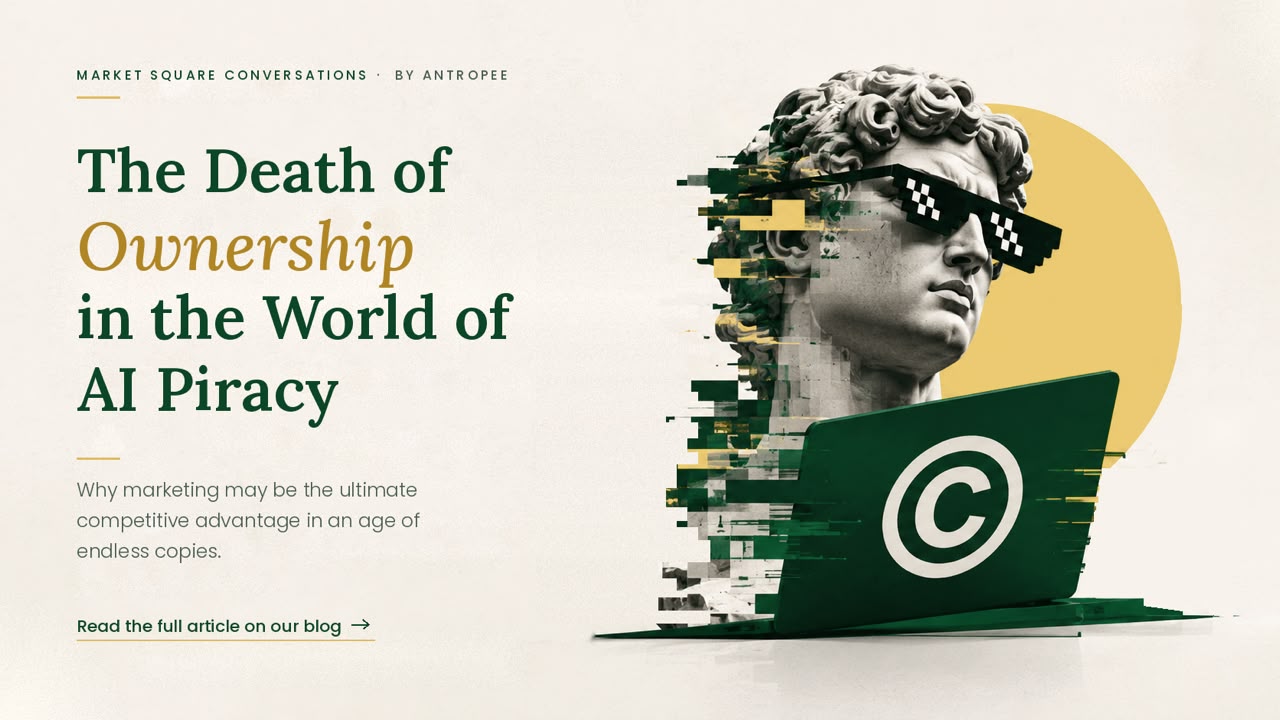
For centuries, ownership was the foundation of economic power. Businesses protected inventions, guarded trade secrets and built a competitive advantage around products others could not easily reproduce.
Artificial intelligence (AI) is challenging that assumption. What once took years of experience, specialised skills or heavy investment can now be attempted with a few well-written prompts. If almost anyone can reproduce what you spent years creating, what does ownership guarantee?
The short answer: in an economy where products can be copied, marketing, brand equity and customer trust become the most defensible competitive advantages.
How Generative AI Is Creating a Crisis of Originality
Most talk about AI centres on productivity and innovation. Less attention goes to what happens when imitation becomes far cheaper than creation.
AI-generated imitation, lawful use of public information and actual copyright infringement are not the same thing. But the boundaries between inspiration, imitation and appropriation are getting harder to see, and businesses feel the effect:
Fashion: A company invests in an original design, then sees similar products sold by competitors at a fraction of the price.
Marketing: An agency develops a distinctive campaign, and another company replicates its execution with generative AI.
The original creator may have invested far more, yet the market does not always reward the original.
When the Product Is No Longer the Competitive Advantage
Product features, proprietary technology and exclusive designs still matter. Patents, trademarks, copyright and trade secrets remain essential. But legal ownership alone does not guarantee commercial dominance.
The easier it is to copy what a product looks like and does, the more important it becomes to ask why customers choose one business over another. Why keep buying from you when a rival offers something almost identical at a lower price?
The answer lies beyond the product. It lies in the brand.
Marketing as a Defence Against Commoditisation
Marketing is often reduced to ads, social media and promotions. Its real value goes deeper: it establishes relevance, communicates value and builds the relationships that shape how customers perceive an offering.
In an economy where products can be copied, brand perception becomes a powerful differentiator. Customers buy the reputation behind a product, the experience around it and the confidence the brand gives them. A competitor can copy your packaging or advertising style. Copying years of customer relationships, credibility and emotional association is far harder.
This is the power of brand equity: the value a business earns through customer trust, recognition and loyalty.
Trust and Authenticity: The New Economics of Brand Building
As AI-generated content spreads, it becomes harder to tell what is original. That is both a challenge and an opportunity. Brands that prove their authenticity, communicate transparently and consistently keep their promises gain an advantage technology cannot easily reproduce.
But authenticity cannot be just a slogan. It must be backed by real practices, from how products are sourced and made to how customers are treated after the sale.
AI and African Businesses: Turning Access Into Advantage
For African businesses, this matters especially. There is a danger of becoming consumers of technologies developed elsewhere while struggling to protect the value created locally.
There is also an opportunity. AI has lowered barriers to entry, letting small and medium-sized enterprises (SMEs) create content, analyse markets and automate processes that once needed large budgets. But if every business has the same tools, those tools become the baseline, not the differentiator.
Sustainable businesses cannot rely only on the uniqueness of what they produce. They must invest in the brand, reputation and customer relationships behind it.
Ownership May Change, but Value Must Remain
Ownership is not disappearing. What is being disrupted is the traditional link between ownership, exclusivity and competitive advantage.
The future may not belong to the company with the most original product or the biggest intellectual property portfolio. It may belong to the one that understands its customers best, earns their trust consistently and gives them a compelling reason to choose it.
Written by
Bolade Adelaja
Digital Media Manager at Antropee. Writing about marketing strategy, brand-building, and growth in African markets.